Navigation - IMPORTANT
Please ensure that you use the navigation "buttons" throughout this website, whether they be the coloured bars above or text displays. Using the "Back" button will not facilitate in browsing this web site.
Comments to web designer
Original Paintings and Drawings
Neils art covers a wide range of artistic mediums, styles and subjects. Please click on each separate medium to find the opening page for that gallery.
Giclee Printing
Details about the digital method of fine art printing. Please click here to find which pictures are available as Giclee prints and more details about each edition.
Sculptures
Please click here to see Neil's collection of limited edition fine art bronze sculptures.
About the Artist
Please click here to know more about Neil Lawson Baker.
Leave Neil a message
Please click here to leave Neil a message and also find our contact details. We would be delighted to see you at our studios by appointment and you will be welcomed with a glass of fine Pierson Whitaker Champagne.
Log In
Customers who have bought from us or have registered for our newsletter can log in here. You will need your membership number and email address to do so. Otherwise, click on the coloured bars above to look around.
|
|
|
|
|
|
|
Originals Paintings and Drawings
|
|
|
|
|
|
|
|
|
|
|
|
|
|
|
|
|
|
Please remember that 10% of all work sold goes to one of Neil"s charities.
In 1795, Nicolas Jacques Conté, responding to the shortage of graphite caused by the Napoleonic Wars, invented the crayon that is still known by his name. It consisted of a combination of powdered graphite and clay.
In addition to using less clay, Conté's crayons could be manufactured in controlled grades of hardness. The sticks sold as conté crayon today are actually a variety of fabricated chalk.
Enter Conté Gallery
|
|
"Painting is an attempt to come to terms with life. There are as many solutions as there are human beings."
George Tooker (1920-)
|
Watercolour is any paint that uses water as a medium. The paint is usually applied with brushes but some artists use other tools.
It is a very exacting medium because drying occurs quickly but it is possible to remove paint by blotting with an absorbent sponge or paper.
The fact that the colours will flow allows all types of wash effects and Neil uses these techniques to good effect; also using pencil to spread the colour on many of his paintings. It is possible to repaint over watercolour and it can be used quite thickly or very thinly applied. Good watercolours give brilliant and true hues and are very good to work with. Most artists use specially prepared watercolour papers which are quite heavy and have a high rag content with some tooth.
Neil does most of his watercolours on acid free 300-450g/m2 A3 paper
Enter Watercolours Gallery
|
|
"Drawing is not what one sees but what one can make others see."
Edgar Degas (1834-1917)
|
Synthetic paints, with pigments dispersed in a synthetic vehicle made from polymerized acrylic acid esters, the most important of which is polymethyl methacrylate. First used by artists in the late 1940s, their use has come to rival that of oil paints because of their versatility.
They can be used on nearly any surface, in transparent washes or heavy impasto, with matte, semi-gloss, or glossy finishes. Acrylic paints dry quickly, do not yellow, are easily removed with mineral spirits or turpentine (use acetone if those don't remove enough), and can clean up with soap and water.
Enter Acrylics Gallery
|
|
"Painting is stronger than I am. It can make me do whatever it wants."
Pablo Picasso (1881-1973)
|
A technique involving the use of two or more artistic media, such as ink and pastel or painting and collage, that are combined in a single composition.
Neil often uses watercolour washes with Conté and highlights with Acrylics. A host of different media may be used to obtain textures and effects.
Enter Mixed Media Gallery
|
|
"Drawing and color are not separate at all; in so far as you paint, you draw. The more color harmonizes, the more exact the drawing becomes. When the color achieves richness, the form attains its fullness also."
Paul Cézanne (1839-1906)
|
Oil painting is done on surfaces with pigment ground into a medium of oil - especially in early modern Europe, linseed oil. Other oils occasionally used include poppyseed oil, walnut oil, and safflower oil. These oils result in different properties in the oil paint, such as less yellowing or different drying times.
Enter Oils Gallery
|
|
"Painting is just another way of keeping a diary."
Pablo Picasso (1881-1973)
|
Depiction of shapes and forms on a surface chiefly by means of lines. Color and shading may be included. A major fine art technique in itself, drawing is the basis of all pictorial representation.
Drawing has been highly appreciated since the Renaissance, greatly because it implies spontaneity -- an embodiment of the artist's ideas.
Enter Pencil Gallery
|
|
"What is drawing? It is working oneself through an invisible iron wall that seems to stand between what one feels and what one can do."
Vincent van Gogh (1853-1890)
|
|
|
|
|
|
|
|
|
|
|
Giclee Prints
|
|
|
|
|
|
Click here for GICLEE PRICE LIST
|
|
|
|
|
This is a new form of fine art reproduction
Giclee (pronounced G clay) is a French term. It simply means 'to squirt'. This is exactly what the archival, laboratory tested inks do when they coat high quality art paper or specially prepared canvas with pigment.
In the past it was sometimes referred to as an Iris Print due to the fact that the brand name of one of the first digital printers was Iris!
The Giclee process, quite different from the traditional off-set lithographic prints that artists have previously used to reproduce their works, can give a much truer match to the original picture.
Giclees are superior to traditional lithography in several ways. The colours are brighter, last longer, and are produced with such high-resolution that they form a virtually continuous tone, rather than tiny dots. The gamut of colours for giclees is far beyond that of lithography.
|
|
|
|
|
|
|
Page 2
|
|
|
|
Giclee Prints
|
|
|
|
|
|
Click here for GICLEE PRICE LIST
|
|
|
|
|
|
Lithography uses tiny dots of four colors: cyan, magenta, yellow and black. It 'fools' the eye into seeing various hues and shades. Blends of colour are 'created' by printing different size dots of all four colours.
Giclees use state-of-the-art inkjet technology. The process employs six colors; light cyan, cyan, light magenta, magenta, yellow and black, with very high quality lightfast inks. The six print-heads give a wide colour range and can print onto quality papers, canvas or board..
The very fine print heads spurt jets of ink in minute droplets at a resolution of 1440 dpi, actually mixing the inks on the page to create true colours. The image is therefore captured, proofed and printed digitally.
The inks are extensively laboratory tested and so colour fast that the works of art they produce may last up to two hundred years before showing any sign of fading, giving a much greater longevity than some original works of art!
Neil's Giclees are all personally signed with his monogram, numbered and dated and sold in strictly limited editions.
|
|
|
|
|
|
Page 1
|
|
|
|
|
Sculptures
|
|
|
|
|
|
|
|
|
|
|
Due to the demands of setting up my first exhibition at The Arts Club, London, I have regrettably been unable to finish this section ready for the launch.
Please accept my apologies and do return shortly as I promise to have the content in place in the very near future.
Neil Lawson Baker
|
|
|
|
|
|
|
|
|
|
|
|
About the Artist
|
|
|
|
|
|
|
|
|
|
Neil Lawson Baker was born in Watford, Hertfordshire, England, UK in 1938. Schooled at Merchant Taylors 1952-57, Neil then went on to qualify in Dental Surgery in 1963 at Guys Hospital and later as a Medical Doctor in 1969 at St Georges Hospital, Hyde Park Corner, in the heart of London.
As a schoolboy he had expressed himself artistically making pottery. Then while at university, as well as playing a lot of sports, he led a mainstream big band, playing saxophone. His group was often booked to play as a second band alongside the famous swing bands of the era.
|
|
Another passion of Neil's was motor cars. During the late 50's and early 60's he successfully raced Vintage Amilcars both in England and France. He now owns two very rare classic French Sports cars, 1964 Facel 6's.
By day a committed professional Dental Surgeon, Neil has never been far away from galleries and museums, travelling worldwide in pursuit of his artistic and medical interests.
During his journeys he acquired rare medical books. This quest was undertaken as a liveryman of The Worshipful Company of Barbers at Barber Surgeons Hall in the City of London where Neil was appointed as the Honorary Librarian to rebuild the company's library, which had been destroyed in the second world war.
Developing a keen eye, he began to collect contemporary art works for his London home and formed a great interest in the sculpture of Rodin and his school of followers.
|
|
|
|
|
Page 2
|
|
|
|
About the Artist
|
|
|
|
|
|
|
|
|
|
This passion was helped by meeting Adrian Maeght, the famous French art gallery and museum owner, who happened to be competing alongside Neil in the Paris - Nice vintage car rally in 1970.
Invitations to visit the Galerie Maeght in Rue du Bac in Paris and later the Fondation Maeght in St Paul de Vence to see paintings, sculpture and lithography by Picasso, Miro, Leger, Calder, Arp and others, had a huge influence in what was to come.
|
|
|
After years of looking and collecting, in 1987, during his recovery from a serious illness, Neil suddenly decided to produce his own work and began to model sculptures as recuperative therapy!
Naturally he already had the hand - eye skills of a surgeon, but he was also fortunate enough to receive a lesson from Kees Verkade, a well known Dutch Sculptor. Kees showed Neil how to model using Tiranti sculpting wax and aluminium armatures.
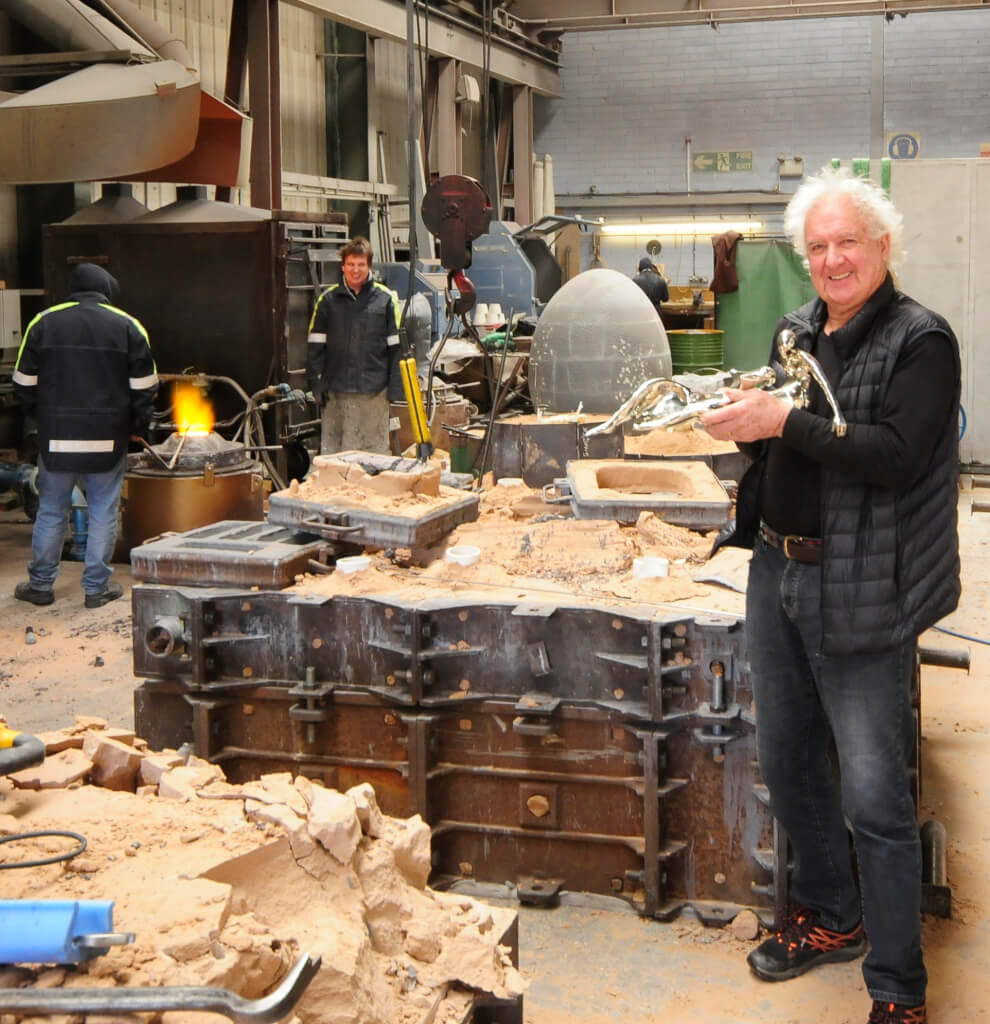
Within a short time Neil found himself immersed in a totally new world. Friends formulated introductions and he soon met up with Eric Gibberd at the Burleighfield Foundry who was responsible for most of Barbara Hepworth's castings as well as those of many other famous artists.
Eric became Neil's friend and mentor. He took him to Paris to meet Charles Pinellis at the famous Susse Fondeur in Arcueil. With all this professional help he was soon involved in casting many bronze sculptures both in the UK and France and began selling to private collectors and then to corporate clients.
|
|
|
|
|
|
|
|
Page 1
|
Page 3
|
|
|
|
About the Artist
|
|
|
|
|
|
|

|
|
This website will follow the development of the art of this well known Londoner who as he begins to contemplate the gradual end of his surgical career will immerse himself in his new found passion.
PLEASE DO WATCH THIS SPACE !!...................................
More importantly, help Neil to continue funding a hospice.
|
|
Having been responsible for his Facel 6 driving Around the World in 80 Days to celebrate the Millennium, Neil raised many thousands of pounds in sponsorship from this event for Helen House Children's Hospice.
He is now pledging 10% of all his net Art income to both Helen House and Douglas House hospices. The latter is a new hospice recently founded by Sister Frances Dominica, for children who have survived and passed the age of 16yrs who are not eligible to stay at Helen House.
Please do link from this site to the Helen House and Douglas House sites and read about their work. These children and their devoted parents need all the help available. Please consider a tax efficient donation or a legacy to this very worthy cause.
Also visit www.chearishfund.org which is Neil's own site raising money for the hospice.
Thank you for looking at this site and the details about the hospices.
|
|
|
|
|
|
|
|
Page 3
|
|
|
|
|
-
|
|
|
|
|
|
|
|
|
|
|
|
|
|
|
|
|
|
|
|
|
-
|
|
|
|
|
|
|
|
|
|
|
|
|
|
|
|
|
|
|
|
|
-
|
|
|
|
|
|
|
|
|
|
|
|
|
|
|
|
|
|
|
|
|
-
|
|
|
|
|
|
|
|
|
|
|
|
|
|
|
|
|
|
|
|
|